
von Kathrin M.
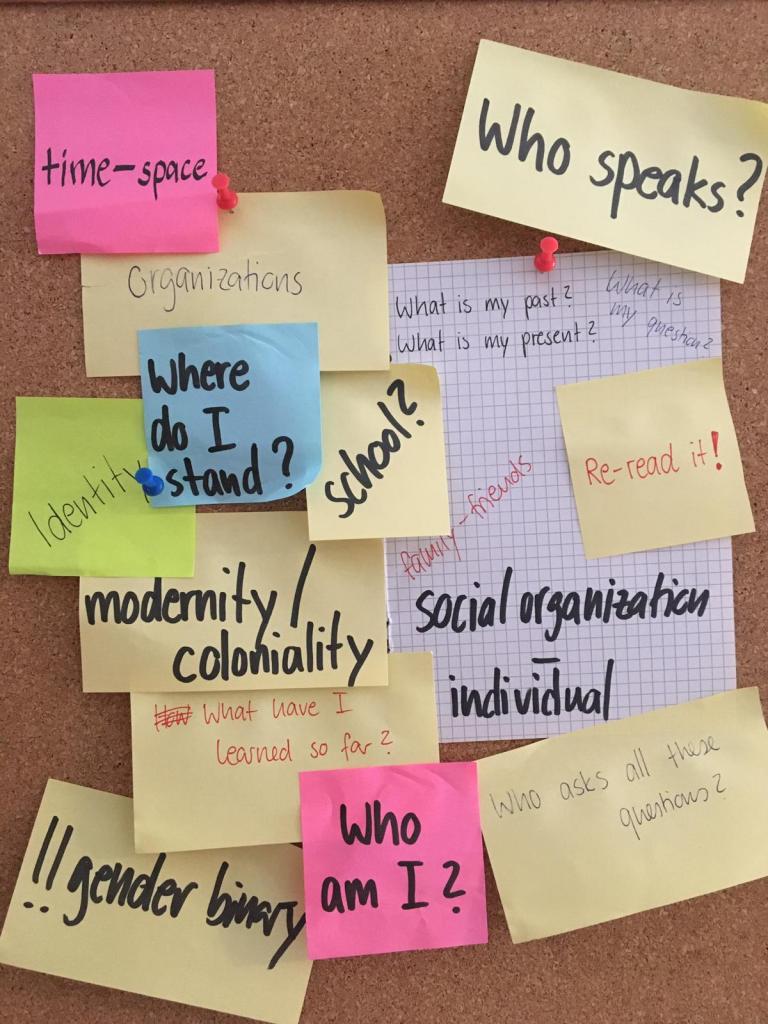
What do we mean when we speak about positionalities? What is my positionality and why is it important to ask this question before writing something someone else might read? In stark contrast to the positivist thinking of “modern” sciences and the call for or assumption of neutrality and objectivity, critical thinking and research demands to engage with one´s own positionality – mirroring not (only) our geographical location but rather our epistemological location and “interpretative horizon” (identity). It is not possible, neither desirable to detach from this – from the ways we see, interpret and understand the world. Modernity/ Coloniality[1] (to use Mignolo´s concept) did not only complicate the world for us by separating domains like the social from the political and economic … etc., but proposed the existence of a single, universal truth – that did and will never be able to capture the complex realities we[2] live. Further, it makes us believe that we can come to understand everything and everyone when using our rationality as independent autonomous beings, always thriving for “higher civilization”. We live in a world where minority knowledge and minority worldview were forcefully transformed into majority knowledge and worldview over hundreds of years. I have learned to interpret the world, my environment, my being and my country´s history from a Eurocentric perspective, that causes harm, violence, shame and ignorance until today, but at the same time encourages me to question the very framework I have been born and raised into. The ways we learned to act, think and be, in largely binary terms and categories – the ways certain experiences became essential and naturalized – leaving no space to question, counter and criticize without the danger to face resistance, rejection, harm, violence, or death. So what does it mean: positionality?
Positionality can mean many things and be embraced in many ways. Nevertheless, I would argue it means how I position myself in this world and in relation to others. It captures the way(s) in which I and others are related. Crucial aspects of this include our social and cultural capital, our class, race, gender identity, the language(s) we speak, religion, spiritual affiliations, family status, HIV status, geographic location, Global North/ South, sexuality, professional alliance(s), rural – urban, our historical involvement in xyz, privileges, power…
Positioning ourselves or encountering our own positionality is so crucial for any aspect of life, because it allows to see what has been and is neglected or naturalized within our own experiences. It allows us to discover the discourses which regulate our own narratives – our identities and subjectivities. What do I or what do others take for granted within my own life? It enables me to ask: What can I (not) see from my positionality?! What might others be able to see from theirs, that I cannot? What can my positionality reveal that other´s can’t?
Asking from where WE, from where I speak is not an easy question – but it is an important and interesting question. A question to which the answers are fluid and develop over lifetime – answers that help us look deep down into who we are (at a certain point in life), and which helps us not only to accept where we are, but also to grow from where we are.
In this sense I make a try in stating: I am a white, young, German woman – identified as female and (mostly) heterosexual, temporarily able-bodied, raised and educated in a former colonizer country that embraces a western-liberal worldview embodying a linear understanding of time (future oriented), largely rule-based oriented with a mostly lateral social organization and strong accentuation of the individual. Further, I am a daughter and sister, a social worker and aligned with certain peace, social justice and postcolonial movements/ organizations, as well as the academic space. I am filled with questions and curiosity, with positive and negative emotions, (un) thinkable visions of the future and dreams that have to be dreamed.
[1] Understood as a concept first used and studied by Aníbal Quijano (later developed by Walter Mignolo). It refers to the way in which the concepts (modernity and coloniality) are inseparable – two sides of the same coin. Like many postcolonialists, decolonialists seek to draw attention to the relation between colonialism and the narrative of modernity, through which much of the world’s history has come to be understood. Modernity, then, is viewed as an epistemological frame that is inseparably bound to the European colonial project.
[2] Now that I have been and will be using this „generalization“ a few times, I also want to shortly explain what I intend to mean when saying we: WE in this text intends to capture and include everyone who wants to critically reflect on what it means to be human in our current world. Who wants to critically reflect on their own positionality – their role in history, our present and our future; who wants to investigate and name systems of oppression and unequal power relations; who acknowledges the interrelatedness of all Beings – resisting the Cartesian image of what it means to be human.
 Postcolonial realities
Ein Kommentar zu “WHO SPEAKS ?! – let´s talk about positionalities”